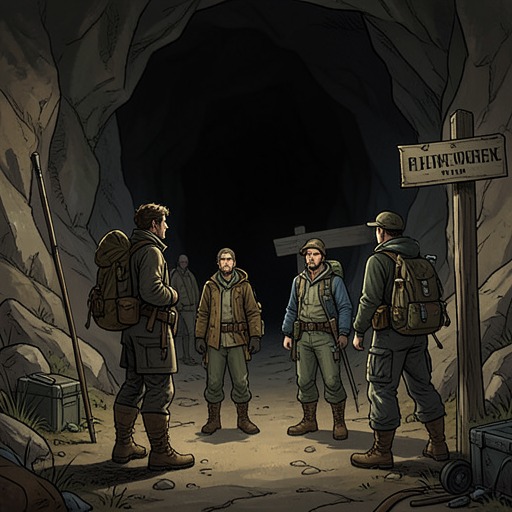
Entering the Underground Passage
A Journey to the Centre of the EarthEntering the Underground Passage is the moment Professor Hardwigg’s projected expedition becomes an actual descent into the Interior of the Earth. On Monday, June 29, the three travelers leave the surface behind and enter a tunnel shaped by lava, using instruments, electric light, and a carefully devised rope system to make the first stage of the journey possible. The scene joins scientific record-keeping to practical risk: a date and compass bearing mark the beginning, but the steep passage makes clear that observation alone cannot carry them downward.
Preparations and the threshold
Before setting out, the expedition organizes its equipment into four groups: instruments, arms, tools, and provisions. The instruments include a centigrade thermometer rated to 150 degrees and a compressed-air manometer intended to measure pressure as they descend. These tools embody the expedition’s ambition to observe and measure the subterranean environment, while Harry’s reservations about the thermometer’s range suggest how little certainty even their best preparations can offer. The group does not enter with knowledge of the conditions below; it carries instruments meant to discover them.
The physical problem of getting down the shaft has also required an improvised solution. Its sides are nearly vertical, broken by projecting ledges that could serve as footholds, but a rope left anchored at the surface would be difficult to retrieve from below. Professor Hardwigg answers this by using a cord about as thick as Harry’s thumb and roughly four hundred feet long. He loops it over a large block of lava at the edge, then sends both halves down. At intervals, each traveler can release one end and pull the other so the cord falls within reach, allowing the same method to be repeated farther down. The arrangement makes descent feasible, though Harry remains preoccupied with the unanswered question of how they might climb back up.
At the entrance, the expedition converts uncertainty into a measured starting point. After breakfast on biscuit and dried meat, with water flavored by Schiedam, Professor Hardwigg opens the notebook reserved for travel memoranda. Its entry records Monday, June 29, at 8:17 in the morning; the thermometer reads six degrees, and the compass indicates east-southeast. These details locate the party in time and direction, turning the threshold into a datum that can be compared with later observations. The record does not make the route safe, but it establishes the expedition’s practice of documenting movement as it occurs.
The first descent
Professor Hardwigg announces that they are taking their first step into the Interior of the Earth and that their travels truly begin at this precise moment. His declaration gives the passage a formal threshold: the party has left preparation behind and entered a place presented as untouched by human visitors since the world’s creation. The compass’s east-southeast bearing identifies the obscure gallery ahead, while the notebook fixes the moment from which the underground journey will be measured.
Light is essential to making that declaration actionable. Professor Hardwigg carries the Ruhmkorff apparatus around his neck and connects its electric current to the lantern’s mechanism; the dark tunnel is at once illuminated. Hans operates a second apparatus, so the travelers can move by artificial light even amid gases described as highly inflammable and combustible. The equipment does more than improve visibility: it creates the conditions under which the party can advance through a dangerous environment. The narrative’s image of a sudden brightening is therefore both spectacle and infrastructure, a technical achievement that permits the next step while leaving the hazards intact.
Professor Hardwigg goes first, Hans follows, and Harry brings up the rear, each carrying a burden. As they enter, Harry looks back up the tube-like shaft toward the Icelandic sky and recognizes that it may be the last sky he ever sees. The glance back makes the threshold irreversible in feeling, even before the travelers know what the route will bring. The surface remains visible for a moment, but the expedition’s movement is inward, away from the ordinary world and toward conditions they cannot yet predict.
Lava, terrain, and risk
The tunnel bears the material trace of Sneffels’s 1219 lava flow, which forced its way through the passage and left a thick, brilliant coating across its interior. Under the electric lamps, that coating intensifies the spectacle of the descent. The gallery is not merely a natural corridor: it is a passage transformed by an earlier volcanic event, and the expedition now travels through the cooled remnant of that force. Light reveals the lava’s surface, but its beauty does not soften the practical difficulty of crossing it.
The route slopes steeply enough to threaten the party with a fall. Cracks, abrasions, and other uneven places provide footholds, but the travelers have to descend slowly, letting their heavy luggage slide ahead on a long cord. The same irregularities that make progress possible also make it uncertain: features that serve as steps in one place appear elsewhere as stalactites. Lava that is porous in some areas has formed small rounded blisters, while crystals of opaque quartz and clear natural glass hang from the roof and catch the electric light. Harry’s account lingers over these formations, presenting an underground landscape that appears almost deliberately illuminated even as its surfaces complicate every movement.
That contrast defines the beginning of the journey. The first passage is at once a recordable route, a hazardous slope, and a striking geological display. The instruments promise measurement; the rope and lamps provide limited control; the lava’s unstable footing reminds the explorers that the environment sets the terms. Entry is therefore not a simple crossing of a boundary but the start of a negotiation between human equipment and a world that remains only partly legible.
Narrative significance
The scene establishes the expedition’s working pattern: Professor Hardwigg supplies plans and technical solutions, Hans contributes practical competence, and Harry records the physical and emotional uncertainty of following them. The notebook’s exact time and bearing stand beside Harry’s fear that he may never see the sky again. Scientific procedure and personal apprehension are not separate tracks; both register the same descent, one through measurements and the other through the costs those measurements cannot settle.
The instruments, cord, lanterns, and luggage make the expedition’s dependence on material means explicit. The group’s movement rests on a chain of practical actions: equipment is selected, a cord is anchored and lowered, instruments are recorded, electric light is activated, and burdens are controlled on the slope. Each device helps solve a specific problem, yet none removes the underlying uncertainty. The rope handles the descent but does not answer the problem of return; the lamps illuminate the tunnel but do not make its gases harmless; the thermometer records a temperature without guaranteeing it can measure every condition they may encounter.
By ending the scene’s initial movement with the travelers inside a lava-lined gallery, the narrative makes the underground journey concrete rather than merely speculative. The precise journal entry gives the passage a documentary frame, while the illuminated mineral formations and Harry’s backward glance lend it the gravity of departure. From this point, the expedition’s claims about the earth’s interior must be tested against the demands of moving through it.